
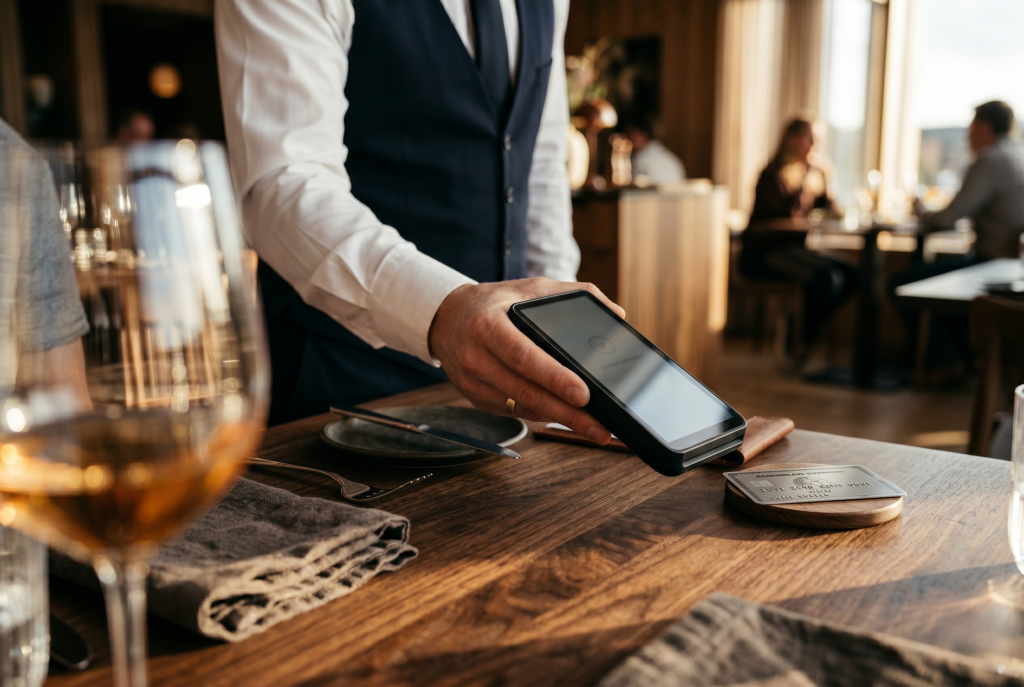
For 18 years, we have been working on one simple thing: making it easier to manage your property.
The more we simplified things, the clearer a nagging pain became: the gap between Sirvoy and anything else you use for sales in a restaurant, cafe, breakfast bar, bar or gift shop.
That’s why later this year we’re rolling out I serve the points of sale — an integrated point of sale for hotels, guesthouses, inns and guesthouses. We are starting in Sweden, and other countries will follow soon after.
Why a point of sale, and why now
Many properties we work with that operate a restaurant, cafe, bar or store are juggling two systems. Sirvoy for reservations. Something else for the restaurant, cafe, bar, breakfast service or gift shop. A few don’t have a real point of sale and use bookable extras as a workaround – which holds up well until you have more than twenty of them.
Either way, it costs you. Two connections. Daily totals that don’t quite add up. Items entered twice. Walk-in receipts that don’t really fit either system.
You’ve been telling us this for some time, through surveys, support tickets, and meetup discussions. The pattern was clear: many things could be simpler if reservations and points of sale lived in the same system.
So we built one.
What Sirvoy POS does
The whole product is built around one practical idea: a system, a connection, a bill.
Sirvoy POS has its own screen. This is a register, designed for a cafe counter or restaurant pass, not the Sirvoy admin you already know. But underneath, it’s the same Sirvoy. Same account. Same guests. Same rooms. Same income.
Your team logs in with the credentials they already use: no second account, no additional password.
Restaurant, cafe or bar fees post directly in the guest room. At the time of payment, the customer receives an invoice covering room, breakfast, drinks and shop. No reconciliation of totals in the end because point-of-sale sales and booking revenue come from the same place.
This is not an integrated third-party point of sale. It’s our own product, built by the same team, designed to work with the rest of Sirvoy from the inside out.
Here’s what your team gets at launch:
- a clean recording screen with a product grid, categories and shopping cart
- the ability to post a sale directly to a guest’s room or by booking
- an invoice at the checkout covering reservations and points of sale
- a Sirvoy account for everyone — same identifier as at reception
- A table plan with flux park, split and charge for restaurants, breakfast service and bars
- kitchen ticket printing for properties that need it
- map via Striped terminal (the same Stripe you can use for direct bookings) and species
- received without appointment that meet Swedish tax requirements from the start
- Reports of day X/Z that combine point-of-sale sales and booking fees into a single report
- works on the device you already own: iPad, computer, whatever your team is comfortable with
It’s not just for hotels
Sirvoy serves more than 4,000 properties in over 140 countries. These are of course hotels, but also a large community of B&Bs, hostels, guesthouses, vacation rentals and small lodges. Our founder John built Sirvoy for his mother Birgitta, who needed an easy way to manage reservations at her own Swedish hostel. Family business, family idea.
Sirvoy POS is aimed at the part of this family that manages food, beverage or in-store sales alongside reservations: restaurant, cafe, bar, gift shop, breakfast (included or a la carte), late night fika. Most commonly hotels, B&Bs, inns and guesthouses, but any small property with some dining or retail next door is also suitable.
How this will happen
Honestly: we pay attention to timing. We’re testing throughout the summer, then running a closed beta with a small group of Swedish properties until the fall. General availability for Swedish hotels and B&Bs from November 1, 2026.
Until then, you can register on the waiting list. We will contact you as soon as the pilot opens.
One thing we want to be clear about: nothing about your existing Sirvoy changes. You’ll see Sirvoy POS pop up as something you can enable if it’s convenient for you, when you’re ready. No forced migration. No surprise price changes to your current plan.
Be the first in line
We’ll keep this blog updated as the pilot takes shape: what’s working, what we’re adjusting, and what’s next.
— The Sirvoy team
PakarPBN
A Private Blog Network (PBN) is a collection of websites that are controlled by a single individual or organization and used primarily to build backlinks to a “money site” in order to influence its ranking in search engines such as Google. The core idea behind a PBN is based on the importance of backlinks in Google’s ranking algorithm. Since Google views backlinks as signals of authority and trust, some website owners attempt to artificially create these signals through a controlled network of sites.
In a typical PBN setup, the owner acquires expired or aged domains that already have existing authority, backlinks, and history. These domains are rebuilt with new content and hosted separately, often using different IP addresses, hosting providers, themes, and ownership details to make them appear unrelated. Within the content published on these sites, links are strategically placed that point to the main website the owner wants to rank higher. By doing this, the owner attempts to pass link equity (also known as “link juice”) from the PBN sites to the target website.
The purpose of a PBN is to give the impression that the target website is naturally earning links from multiple independent sources. If done effectively, this can temporarily improve keyword rankings, increase organic visibility, and drive more traffic from search results.
Jasa Backlink
Download Anime Batch